A property feasibility study answers one question: will this building work for the use you have in mind? It is a short piece of professional work, usually carried out before you commit to buying, that tests a building against design standards, planning rules and simple arithmetic.
Most developers learn the value of this the hard way. A building that looked like a ten-flat conversion turns out to support six once space standards are applied, or a planning constraint surfaces after exchange and the numbers stop working. A feasibility study exists to catch these problems while you can still act on them.
What a property feasibility study covers
A feasibility study for a building conversion looks at three things: the building, the planning context, and the numbers that connect them.
First, the building itself. An architect tests the floor plate against the use you want. Where do the stairs and cores sit? How deep is the plan, and can every habitable room get natural light? How many units or rooms fit once corridors, risers and minimum space standards are accounted for?
Second, the planning context. This covers the current use class, whether permitted development rights apply, and any constraints such as conservation area status, listing, flood risk or an Article 4 direction. These factors decide which planning route is open to you and how much risk sits on it.
Third, the metrics. A good study measures how efficiently the building converts: how much of the gross internal area becomes lettable or sellable space, and how the resulting scheme compares with the price being asked.
These three strands are assessed together because they interact. A layout that fits more units may fail on daylight, and a planning route that looks fast may fall away once a constraint appears. The study's job is to find the scheme that survives all three tests.
It is also worth being clear about what a feasibility study is not. It is not a structural survey, a formal valuation or a planning application. It is the earlier, cheaper piece of work that tells you whether those larger costs are worth incurring at all.
When to commission one
Timing matters as much as content. A feasibility study delivered after you have committed to a purchase can only confirm or ruin your mood. Delivered before, it changes decisions. There are three moments when it earns its fee.
Before you exchange contracts
Exchange is the point of no return. Before it, you can renegotiate or walk away at little cost. After it, every problem the building hides becomes your problem. A study commissioned during due diligence gives you evidence while you still have options, and a five day turnaround fits comfortably inside most transaction timetables.
Before you bid
Auctions and competitive offers force you to commit to a price before you fully understand the asset. A feasibility study gives you a defensible unit count, and the unit count drives everything else: rental income, build cost and end value. Bidding without one means guessing, and guessing against better-informed buyers is an expensive habit.
Before a pre-application meeting
Thinking about a conversion?
Get a clear Go or No-Go on your building in five days, for a fixed fee.
Pre-application advice from the council is far more useful when you bring drawings, a schedule of accommodation and a specific proposal. Officers can respond to something concrete rather than a vague description, and their written response carries more weight later in the process. A feasibility study gives you exactly that material.
What a good one includes
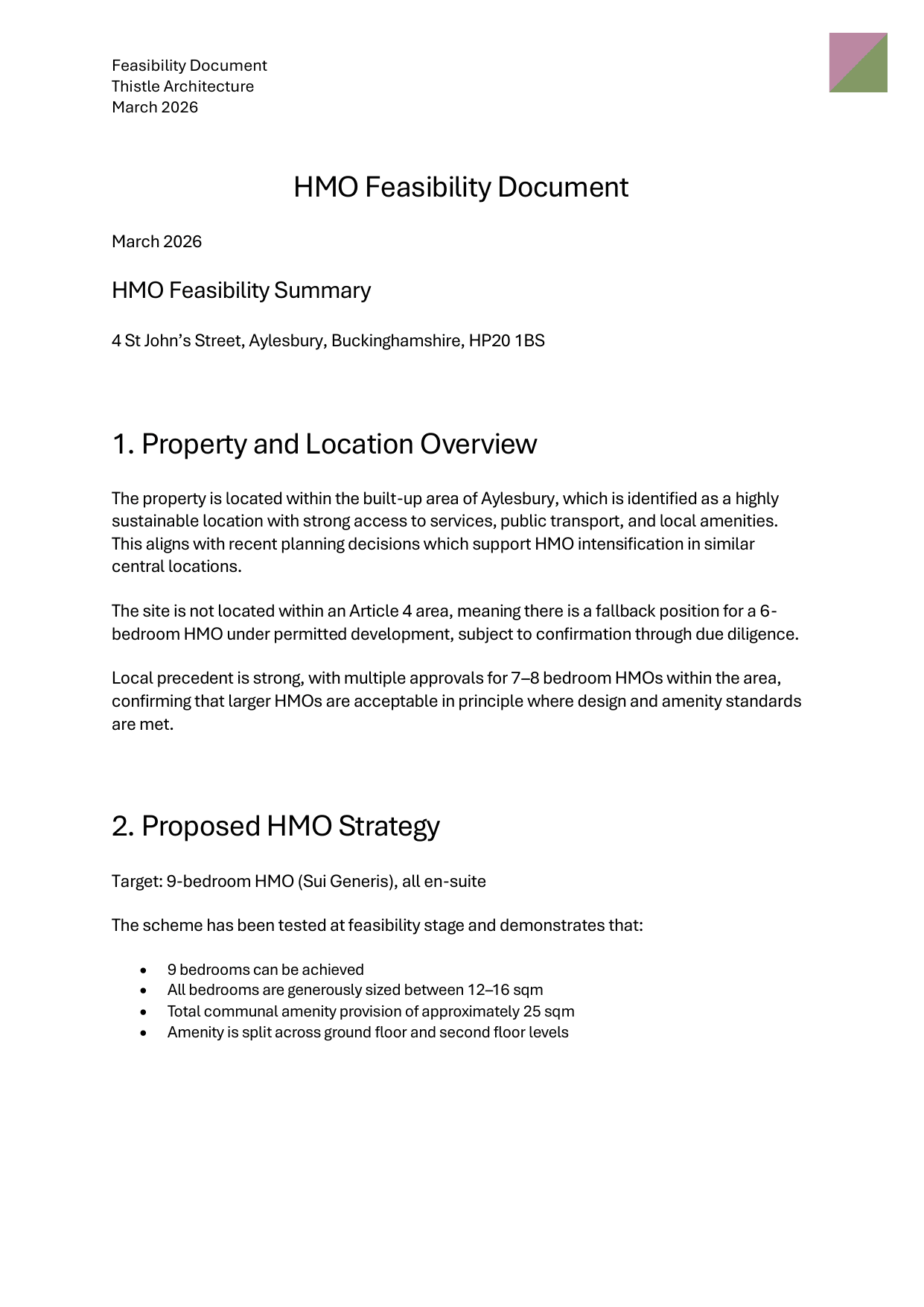
Reports vary widely across the industry, in both scope and quality. Ours contains five deliverables, and we would argue any credible feasibility study should include the same:
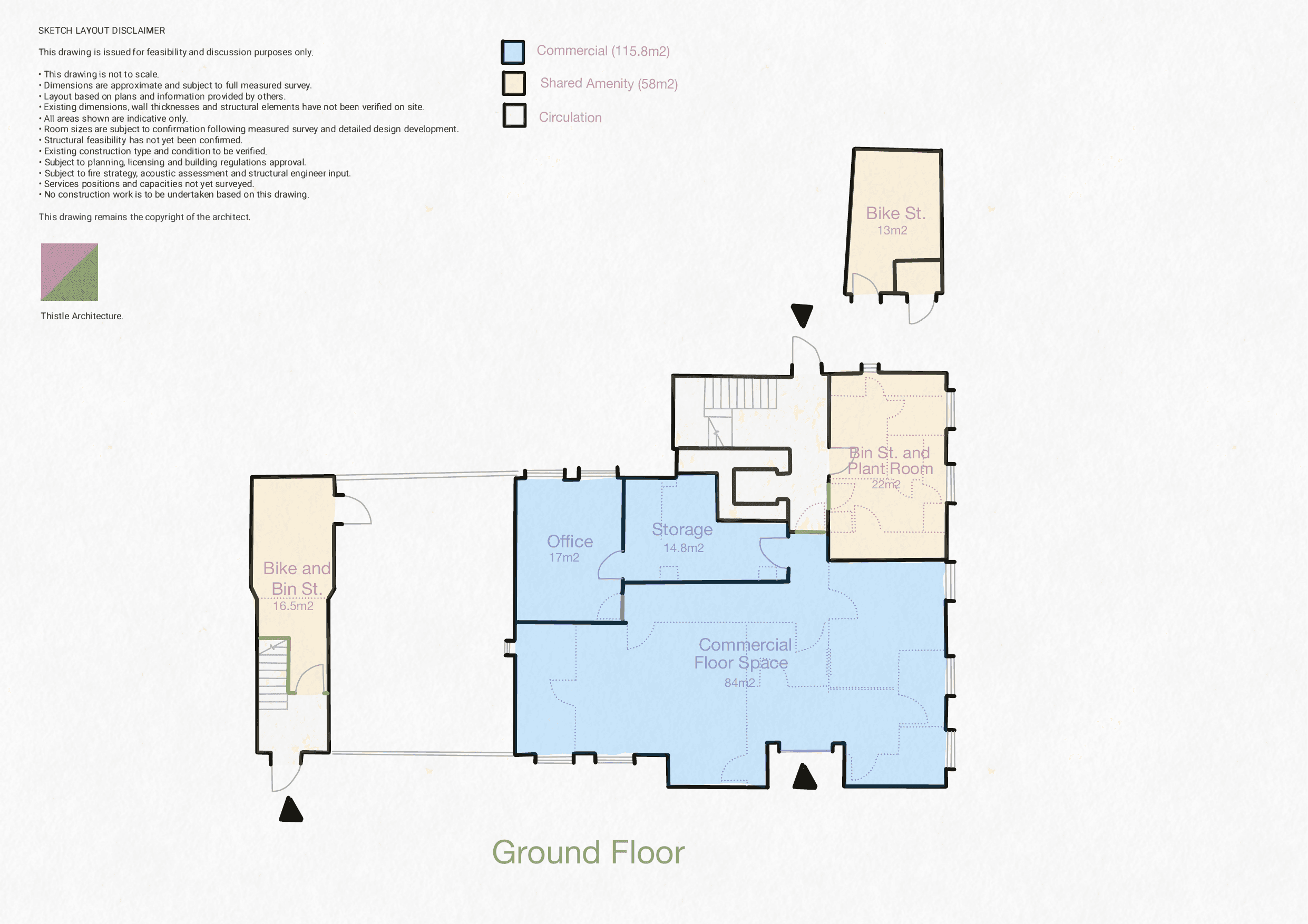
- Sketch schemes: one to two layout options drawn over your existing plans, to scale, so the unit sizes are real rather than hopeful.
- Schedule of accommodation: a table listing every unit or room with its floor area, checked against the relevant space standards.
- Planning policy analysis: a review of every planning and physical constraint on the site, from use class and Article 4 directions to flood risk and heritage designations.
- Risk register: the known unknowns, each with an assessment of likelihood, impact and the likely cost of dealing with it.
- Go/No-Go recommendation: a clear answer on whether to proceed, supported by the evidence in the report rather than left to the reader.
- Efficiency metrics: the ratio of usable space to gross internal area, which drives income, end value and the comparison between schemes.
If a report you have been given is missing several of these, treat that as a warning sign. We have written a separate guide on the five red flags to look for in a feasibility report.
Feasibility study vs development appraisal
The two terms are often used as if they mean the same thing. They do not, and confusing them causes real mistakes.
A feasibility study answers the physical and planning question: what can this building become, and what stands in the way? A development appraisal answers the financial question: if that scheme is built, what profit remains once the purchase, the works and the finance are paid for?
The appraisal depends on the feasibility. You cannot estimate gross development value without a reliable unit count, and you cannot price the works without knowing their extent. An appraisal built on assumed numbers looks precise and is not.
Our advice is to sequence the two. Feasibility first, appraisal second. The unit mix, floor areas and efficiency ratio from the study become the inputs to the financial model, and the model is only as good as those inputs.
What it saves you
The clearest saving is the abortive cost of a bad purchase. That includes the deposit at risk, the legal and survey fees already spent, and the professional fees on a scheme that was never going to work. Set against those figures, a fixed fee study is inexpensive insurance.
The second saving is quieter but just as real: negotiating position. If the study shows the building supports fewer units than the sales brochure implies, that evidence supports a lower offer with reasons attached. If it shows more than the market assumes, you can bid with confidence while other buyers hesitate.
Refusal risk falls too. Schemes drawn up without a constraints review are the ones that meet an Article 4 direction or a heritage objection at application stage. Finding those constraints in week one, rather than month six, is the difference between adjusting a design and abandoning one.
There is also the cost of delay. Good buildings sell quickly, and a developer who needs six weeks to assess one will keep losing deals to a developer who needs five days. Our feasibility package is a fixed fee from £298, takes five working days, and includes all five deliverables listed above.
Frequently Asked Questions
How much does a property feasibility study cost?
Fees vary with the size and complexity of the building. Our fixed fee starts at £298 and covers all five deliverables, including the full feasibility document and its Go/No-Go recommendation. Set against the sums at risk on even a small conversion, it is a small fraction of the exposure.
How long does a feasibility study take?
Our standard turnaround is five working days from instruction. Elsewhere in the industry, three to six weeks is common, which can be too slow for a live deal. Ask about turnaround before you instruct, because a report that arrives after exchange has lost most of its value.
Do I need to own the building before commissioning a study?
No, and it is usually better if you do not. The study is most valuable before exchange or before a bid, while you can still renegotiate or walk away. We normally work from the address, agent floor plans and marketing material, so early access to the building is not a barrier.